Raccoons
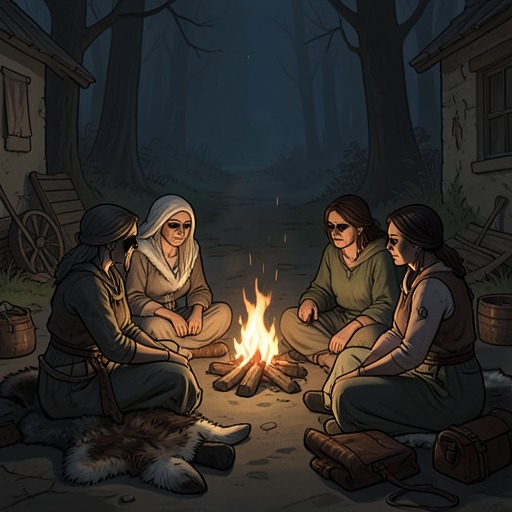
Women TalkingRaccoons are central to an animal story told by Agata Friesen during the women’s meeting, where the animals’ struggle gives concrete form to questions of vulnerability, resistance, and escape. A mother raccoon first loses three of her six young to Dueck’s Rottweiler, then protects the remaining three when the dog is sent after them again. The story’s importance lies not only in what happens to the raccoon family, but in the conclusion Agata draws from it: animals can fight back and run away, while the women have little time to settle what it means to compare them with animals before the men return from the city.
The raccoon family and Dueck’s yard
Dueck has hated the raccoons in his yard for a long time. When the fattest raccoon has six babies, their presence becomes more than he can tolerate, and he orders his Rottweiler to kill them. The dog kills three. The mother saves the other three and leaves the yard with them. Dueck is satisfied, believing the raccoons are gone, and drinks instant coffee while giving thanks for their apparent absence.
That calm does not last. A few days later, Dueck sees the three young raccoons sitting in his yard again and, angry once more, sends the dog after them. The mother is waiting this time. She drives the dog away from the young and drags it into the bushes. The story does not make the mother’s response an abstract symbol detached from events: it follows two separate threats to her offspring, the first of which has already cost three of them. Her second response changes the balance of the encounter and leaves Dueck without his dog.
Dueck searches the bushes for two days and cannot find the Rottweiler. He returns home despondent, wanting the dog back, and finds remains at his door. The ending gives the tale a stark reversal: the man who had treated the raccoons as a nuisance and directed his dog against them is confronted with the loss of the animal he valued. Agata relates this outcome without turning it into a simple account of victory. The surviving young have been protected, but the story’s resolution is marked by loss on both sides.
Agata’s telling and the women’s response
Agata announces that she has her own animal story, also involving Dueck’s Rottweiler. She tells it quickly, in a hushed, theatrical voice, often moving into asides and non sequiturs. That manner makes the account feel like a performance addressed to the group, not merely a report about events in Dueck’s yard. The story builds through repeated commands and reversals: the dog is sent to attack, the mother escapes with some of her young, the young appear again, and the mother is ready when the dog returns.
The women do not respond uniformly. Greta Loewen raises her hands and asks what they are supposed to make of the tale. She frames its possible implication as a question about whether the women should expose their most vulnerable members to further attack in order to draw the men to their deaths and deliver the consequences to Peters, the colony’s bishop. Her response identifies a dangerous reading of the animal story: resistance could be taken to mean deliberately using the vulnerable as bait. The scene therefore places a practical and moral limit around the analogy. A story of an animal protecting her young does not automatically determine what the women should do.
Agata’s answer shifts attention away from deciding whether the comparison is exact. She says that animals can fight back and run away; whether the women are animals, have been treated like animals, or can settle that question is beside the immediate point. The men will soon return from the city. Her conclusion gives the story its urgency: reflection has a place, but prolonged argument over the label could consume time needed for a decision.
Animality, resistance, and departure
The raccoon mother’s actions support Agata’s argument through their sequence. She first removes her surviving young from the yard; when the danger returns, she does not simply repeat that departure but confronts the dog and protects them. In Agata’s telling, animal life includes both escape and active defense. The raccoons therefore complicate any assumption that being called an animal means being merely passive or incapable of response.
The women’s discussion, however, does not collapse human vulnerability into animal behavior. Greta’s alarm makes clear that the comparison can carry a perilous implication if it is used to justify placing exposed people in harm’s way. Agata’s narrower point is that deciding whether the women count as animals is not necessary to recognize the available actions of fighting back or leaving. The tale offers an image for resistance without supplying a complete plan for the group.
Its ending also resists a neat moral. Dueck’s relief at the raccoons’ departure proves temporary; their reappearance renews his anger, and his attempt to remove them permanently costs him the dog he wants back. The mother’s defense of her young changes what Dueck can control, but the loss remains. In the meeting, that unresolved quality matters: the story makes resistance imaginable while leaving the women to judge its risks for themselves. Raccoons are thus more than the subject of a digression. Through Agata’s tale, they become the means by which the group considers whether survival requires flight, resistance, or both—and why the choice cannot be postponed until every analogy is settled.